| www.laurahird.com |
| THE NEW REVIEW |
|
The publisher�s official website
|
 |
|
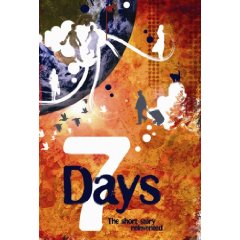
Now here is a book with an agenda, as hinted at by its subtitle and expanded upon by Legend Press MD Tom Chalmers in his introduction: �Seven Days� is an attempt to help revitalise the short story 'by offering an original format, specifically designed for today's reader'. That format consists of relatively long pieces (about 30 pages) that each follow a single character over the course of one day. Whether it's necessary or desirable to 'reformat' the short story in order to get more people reading the form is an open question; for the purposes of this review, it's enough to have an anthology based around a particular theme, and to see what its authors do with that theme. But first, a couple of minor points � personal irritations, really � deserve a mention: it seems a missed opportunity, given the title, not to have a 'full week' of stories (the 'days' are sequenced out of chronological order, and there's an extra Saturday instead of a Monday). On a more practical level, there are also no author biographies; you have to go the publisher's website for those. I know there's no reason why the book has to have either of these features � but, still, I would have liked to see them. Anyway, on to the stories. With 'Friday', Andrew Theophilou demonstrates immediately the possibilities of this anthology's format. His protagonist, Hambis, is a sixteen-year-old boy from a Greek Cypriot family now based in London. It's Greek Easter but, more importantly for Hambis, today is the day of his interview with a prestigious sixth-form college. A place there could well change his life; the snag is that he has to take his parents along to the interview... Theophilou makes good use of the single-day restriction, indicating where Hambis's life has been, hinting at the future possibilities, and showing why this day is so significant. Furthermore, 'Friday' rings true as a portrait of a teenager at a crossroads in his life: Hambis isn't sure about several aspects of his life and identity; one gains a strong impression of someone who has thrown his dice into the air and is watching to see where they land, trying out different ideas to see what works. Even the beginning of the story is slightly overwritten, as a teenager's writing might be (this comment is based on personal experience...). Having said that, I hope this effect was intended; but, even if it wasn't, Theophilou's story is a strong opener. Victoria Mottram's contribution, 'Wednesday', is set in Newcastle-upon-Tyne, and is narrated by Dizzy, a homeless drug addict in need of a fix. Having written in some detail about the previous story, I find I have rather less to say about this one. Mottram's tale is unremittingly bleak, and I can well believe that it's true to life � yet it doesn't move me. Perhaps that's because, whereas Theophilou tells of an exceptional day in his protagonist's life, Mottram seems to suggest that this day of Dizzy's life is much like the rest � which may well be the point; if so, I can appreciate the story intellectually, but not on a deeper level. 'Saturday' by Anca Scott is the story of Amy, a goth and Christian who has been asked by one of her church elders how she can reconcile the two identities. Amy begins the day struggling to answer this question, then goes to her job as a waitress at the Meadow Grove Olive Garden, where she has to deal with a snobbish old enemy from high school. And, if that's not enough for one day, her friends decide that the group are eating out tonight at the Olive Grove; the other staff don't yet know that Amy is a goth, but it looks as though they'll be finding out soon enough... This is another good story, and insightful; as Amy observes, the suburban people around her aren't all that different from herself, in that both can hide their true selves from the world, whether it's behind a work uniform or a rote smile. When we leave Amy at the end of 'Saturday', she has spent the day thinking herself through; and the journey and destination were worth it, for her and for us. The protagonist of 'Thursday' by Anwar Khokhar is Aslam, a Muslim from Pakistan who now lives in Minneapolis. Like Amy in the previous story, he is having difficulty reconciling different parts of his identity: he's wondering if he has lost his values, stuck between two cultures and not quite feeling at home in either. One of Aslam's main concerns is his love-life: his mother is trying to arrange a marriage back in Pakistan to for him, to an attractive, educated girl named Surraya; but does Aslam still have a thing for Britney, his white ex-girlfriend? He has an invitation to a party tonight which, he's pretty sure, Brit will also attend � but he can't decide whether to go. Aslam is an engaging narrator with a distinctive voice, and Khokhar tells his story well, showing there are no easy answers � even when he can be anything he wants, Aslam still isn't sure who he is. But there's also time for humour (Aslam's experience of speed dating, for example); in other words, 'Thursday' is a full and effective story. There is one thing, though, and it's not truly a criticism, but: much of Khokhar's tale consists of Aslam remembering the past, which has the effect of placing the main action out of the story's 'present'. Of course, the stories that make up our lives don't usually fit into a single day, so it's no surprise that the authors that the authors of Seven Days make use of memory and flashback (actually, it's probably essential that they do); but I can't help feeling that using those techniques too much takes the focus off the anthology's main theme. I have a similar feeling about Liilia Morrison's entry, 'Tuesday'. Zucy is a Mayan girl who fell in love at the age of sixteen with an American named Maitland. She went back with him to Boston; but Maitland's family didn't approve of the relationship and paid her to return to her village. Instead of doing so, she remained in the US and now makes a living as a painter. This story brings me to raise the question of how our expectations of an anthology can affect our reactions to a story that pushes the boundaries of the theme. Not only does 'Tuesday' contain a substantial amount of flashback (including one scene with details that Zucy, as first-person narrator, surely couldn't know), it jumps out of Zucy's voice at the end to suggest that it isn't really her story after all. This was all quite jarring to me, but that could be because the previous tales had led me to expect an account of a day that was significant to the protagonist; in contrast, Zucy's day seems to be more significant to another character. Perceived technical hiccups aside, 'Tuesday' is a good read, which is what counts most of all. On we go to the second 'Saturday', this one by E.C. Seaman. Our protagonist here is Johnny, who found fame as a teenage TV star, then went off the rails and is now a drug addict, albeit one with an 'even-more-famous girlfriend' (whom he charmingly refers to as 'the Blonde'). Today, Johnny is interviewed by a journalist from a Sunday paper, only to later discover that she knows about his drugged fling with a politician's daughter... Comparisons with Victoria Mottram's story are perhaps inevitable; it could be argued that Seaman's piece treats its subject matter more superficially (though Johnny hardly has an enviable existence), but I think there's more texture to the prose of 'Saturday'. Seaman's second-person narration works well, simultaneously placing the reader in Johnny's mind and creating a certain distance from the character. There are also some neat turns of phrase; for example: 'You don't tend to see many mornings, at least not from the right end. You kind of approach them from the other direction, bloodshot and bleary.' Still, I don't think there's quite as much to this story as some of the others; there isn't the same depth of significance to Johnny's day. Seven Days began on a strong note with a story about youth and coming-of-age; it ends equally strongly with a story about old age, 'Sunday' by Josie Henley-Einion. It is the ninety-fifth birthday of Miss Harding, a lesbian who lives in her old family seat, now a retirement home. She spends the day looking back on her life, in particular her relationship with her late partner Betty. The narrative voice of this story is particularly notable: it's not easy to write in the first person and make it sound like a character talking rather than an author; but Henley-Einion does so � more completely, I would say, than all the other writers in this volume who choose that mode of narration; Miss Harding springs to life through her brittle, slightly formal, tones. And the memories, which I've had reservations about with some of the other stories, work very well here, as they bring out the contrast between Miss Harding's past and her present � especially when the two are hosted by the same house. I think 'Sunday' answers my question of whether a story where most of the key events take place in the past could be as vital to this anthology as one where the action was located in the present. In his introduction, Tom Chalmers says that Legend Press wanted to 'provide something for everyone' in Seven Days, by showcasing a diversity of stories that still formed a cohesive whole. And, actually, the similarities between the tales struck me more than the differences. It seems that the single-character, single-day format lends itself well to stories of characters wrestling with issues of identity; but there's scope for tales of reflection on life as well. I'm still not sure that modern readers are served any less well by other kinds of stories, but Seven Days represents an intriguing idea, executed well. I'll leave the closing thought to Miss Harding: 'Every day among the ordinary there is something to astonish one.' Quite so. Reproduced with permission

|
| SEVEN DAYS: The Short Story Reinvented Various (Legend Press 2007) Reviewed by David Hebblethwaite |
| If you would be interested in reviewing films/books for the site, contact me here |
| Book Review |
|
About Me Artists Best Tunes Books & Stuff Competition Contact Me Diary Events FAQ's Film Profiles Film Reviews Frank's Page Genre Bending Hand Picked Lit Links Heroes Index Links Lit Mag Central The New Review New Stuff Projects Publications Punk @ laurahird.com Recipes Samples Sarah�s Ancestors Save Our Short Story Site Map Showcase RELATED ITEMSOrder Andrew Blackman�s �On the Holloway Road�
Order Nick Griffiths� �Who Goes There�
Order Josie Henley-Einion�s �Silence�

|