| www.laurahird.com |
| THE NEW REVIEW |
|
Review on the Guardian website


|
 |
|
Against the poignant background of the twentieth anniversary of the Bhopal tragedy, Edinburgh-based author Meaghan Delahunt weaves the stories of three people: an Australian photographer, a Scottish traveller and a Tibetan refugee. Delahunt creates three modern characters who have, at least, two things in common. Firstly, their anger, more upfront in the case of the two male characters, Arkay, the alcoholic traveller turned Buddhist monk and his friend Naga, another monk of Tibetan origin who lost his parents to the Bhopal disaster in 1984 and whose only sister is dying as a consequence of the gas leak. The second detail is that the three characters were born with the umbilical cord twisted around their neck, in the book, a symbol of restlessness, of the constant bouts of escapism and strangeness that overwhelms these three people throughout the novel. It is Fran, the Australian photographer, who introduces us to the story. Born with the rare ability to hear colours and see sounds, she travels to New Delhi, first, and to Bhopal, later, to participate in an artistic project to commemorate the twentieth anniversary of the Bhopal Union Carbide disaster of 1984, and, just when the reader was growing accustomed to Fran�s synaesthetic vision of India and when Delahunt�s prose begins to sigh Rub�n Dar�o or Garc�a M�rquez �fantastic realism� � and the camera clicks turquoise �my favourite sound - a second voice, the one that belongs to Scottish monk named Arkay, drowns us into an even more powerful comparison, Hemingway�s short, sharp, knife-edged, straight-to-the-point phrases:
Now I was here. In India. Wanting to be different. Every Westerner I met it was the same story � wanting to slip off the old self, to become snake-new. You�d think it was the Sixties. Maybe for the West it was always the Sixties in India. I thought it was the last gasp of the Raj; this need to re-create yourself in another culture simply because you could. The sheer fucking luxury of it. It did my head in. Explaining himself in lines like these, Arkay�s voice is, probably, the more accomplished of the three main ones. This is a man who is drinking himself to death, knows it and is unable to stop it. Arkay here is an almost older version of Nic Cage�s character in the film �Leaving Las Vegas�. He yearns for a quiet life, as personified in the owner of the pension in Istanbul where he lives for a while, yet, when a better life comes along, through Fran�s love, he pushes it aside, in disbelief. The third main character in the novel, Naga, the Tibetan refugee turned monk in Bhopal. The most resilient of the three, the most angered one, too, he is, perhaps, the more vague, becoming in the last pages of the book, unfortunately, a mere go-between the other two, the Westerners, the lovers. This reader is left unaware of where his awesome anger comes from though. We know Naga was born in the Tibetan border from parents who runaway from the Chinese invaders. We know he served as a porter for westerners �who dreamt of the slopes� and we know that he lost his family to the Bhopal tragedy:
My body carries this past. The purple marks on my face from the teeth of cold winds. The body remembers. Every time I see a pink face leaning towards me, wanting to know the way out of samsara �this cycle of suffering - I long to show them my missing toes lost to frostbite, and the weft between that still bleeds when I walk. I long to show them my shoes packed with cotton, to ease the pain. Naga�s anger comes from a hardened life and, yet, that anger did not move me as much as doomed Arkay�s anger or the lost Fran. Mixed with the feelings of restlessness, anger and loss, it underlies in the novel a subtle and almost gentle social conscience who questions modern Western tourism in less developed countries such as India or Nepal:
�You climb and we die, sometimes it�s that simple.� There was one man with a small beard, an academic, an expert in Nepal. �But this tourism � it�s a lifeline for you.� He said this very slowly, stressing the syllables for my benefit. �Without it, many of your people would starve.� This criticism laid out in a harsher manner towards the end of the novel, in an abortion clinic:
�Not here. Look around you. Men outside in Range Rovers. They wait for wives, girlfriends or mistresses, for the procedure to be over.� She sighed. �Here is for the wealthy only.� She sighed again and looked at me hard. �Like you�. Delahunt�s �The Red Book�, her second novel, shines with a superb prose that sways from the short, effective sentences by which the doomed Arkay expresses himself to the repressed anger in Naga�s dealings with Westerners or Fran�s sensual vision of the world. It does illuminate dark corners of the soul with a light that does not intend to blind the reader, but to gently point at different shades of greys in the shadows of human nature. Reproduced with permission
|
| THE RED BOOK Meaghan Delahunt (Granta Publications 2008) Reviewed by Raquel Moran |
| If you would be interested in reviewing films/books for the site, contact me here |
| Book Review |
|
About Me Artists Best Tunes Books & Stuff Competition Contact Me Diary Events FAQ's Film Profiles Film Reviews Frank's Page Genre Bending Hand Picked Lit Links Heroes Index Links Lit Mag Central The New Review New Stuff Projects Publications Punk @ laurahird.com Recipes Samples Sarah�s Ancestors Save Our Short Story Site Map Showcase RELATED ITEMS Order Delahunt�s �In the Blue House�
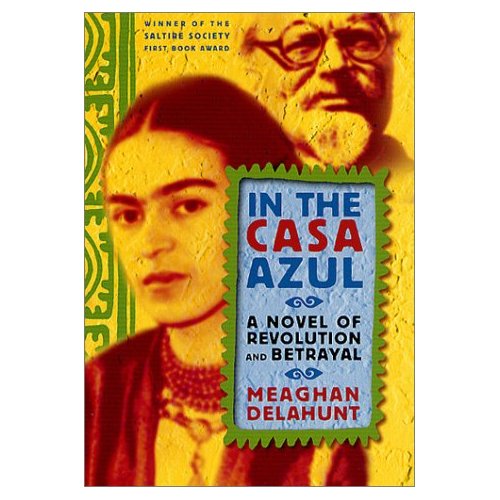
Order Delahunt�s �In the Casa Azul: A Novel of Revolution and Betrayal� Order Jeanette Winterson�s �Written on the Body�
|