| www.laurahird.com |
| THE NEW REVIEW |
|
Extract on the Salt Publishing website

|
||

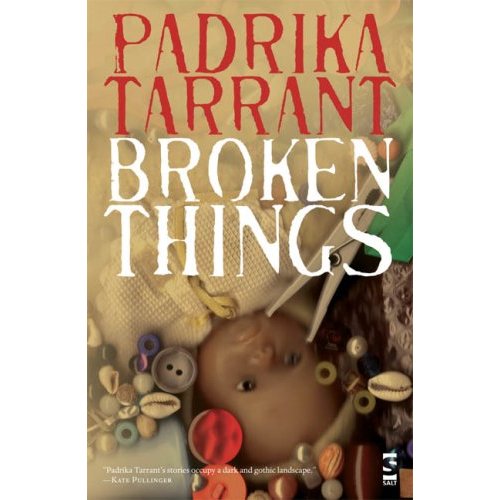
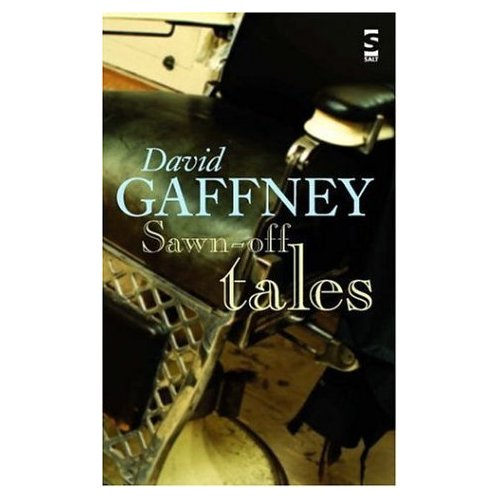
Padrika � it's a lovely name. Where does it come from? It's just a female version of Patrick. Much less interesting than it sounds I�m afraid! Tell me something of your family origins and what you were like as a child. I was number five of seven children, having a brother 10 years older and a sister 11 years younger. It was a chaotic sort of childhood. Will you describe the Bristol of your childhood? What were the main social, political and cultural influences of your youth? I was raised in a church that had Pentecostal, Fundamental, Evangelical written on the outside wall along with a huge white cross. As a child I tried to believe every word. I used to read and re-read the Book of Revelations, try and force it to make sense somehow. I was afraid much of the time; afraid of the devil, afraid in case I wasn�t doing it right, afraid in case I might be damned however hard I tried. Going to the stable, they used to say, doesn�t make you a horse; going to church doesn�t mean you are saved. Salvation was a shifty notion, not quite to be relied upon. I clung to it for all I was worth. What was the first short story or short story collection to have an impact on you? When I was small I had a volume of Hans Andersen�s stories, the real thing that is, not cleaned up or sanitized but raw and poetic and violent. I was horrified and mesmerised by tales like �The China Shepherdess�, where even the happy ending offers scant comfort, given that the Shepherdess and the Chimney Sweep, her sweetheart, lived happily afterward until they were both smashed to pieces. Oscar Wilde�s �Nightingale and the Rose� gave me nightmares. Tell me one of your most vivid memories of the years you spent at the Norwich School of Art and Design. Did you enjoy your student days there? My drug of choice was bronze-casting. I never got bored with the witchery of it, liquid metal pouring from the crucible like thick hot blood. Wonderful. When did you become interested in writing fiction? I wrote my first book in infant school. It had four pages, and was, if I recall correctly, about a vampire bat that flies into a house and watches television. There has never been a time in which I have wholly stopped writing, even if it is only half a page a month. I have been working more seriously since winning the Escalator in 2005. How has Jan Svankmajer's work been important to you? I came across Svankmajer�s films as a child. In the 1980s BBC2 used to broadcast world animation at 6pm, a strange universe of shadows and faces put together from torn photographs. I was about ten when I saw �Down to the Cellar� and it struck me deeply. I rediscovered him as an art student and in fact wrote my undergraduate dissertation about his work. I am fascinated by him, by the way in which household detritus forms creatures charged and trembling with feeling, by the way in which fear may be wrung out of that which is seemingly benign. Tell me about your novel, �The Knife Drawer.� �The Knife Drawer� is the story of a child growing up in a sentient house, her twin who lives in a hole in the garden, and her mother, who murdered her husband and is eaten with guilt. There is an infestation of knives in the dining room, breeding beneath the piano, and the mice have formed a miniature civilisation. Has being Jay's mother made you feel differently about yourself? How do you juggle the demands of motherhood and writing? Jay writes books too, or at least she draws them, and fills them with pretend writing, little squiggles in finicky lines. She says sometimes that she will be an author when she grows up, so she can wear a wrist support for RSI like mine. Other days she plans to be a princess. I could not have written �The Knife Drawer� without being a mother; it encompasses lots of anxieties about motherhood and childhood, of the nightmare mother that I fear becoming and the frightened child at the heart of me. Do you find you have to be very disciplined about setting aside time for writing? Do you write every day? Will you describe your writing environment at home? When I am on a roll I can write every day. I like to write in public with the world going by. A rare treat for me is to write in train stations at rush hour; the roar of the people going past is like the sound of the sea. Failing that, I blast my poor ears with MP3s. Muffins are good. Coffee is essential. I wrote most of my novel in the corner seat on the top floor of Starbucks in Norwich. Typing up is done at home when Jay is in bed, with the TV on for background noise. I like my laptop; it warms my legs like a little sleeping animal. In a Paris Review interview, Paul Auster says, "Writing has always had a tactile quality for me. It�s a physical experience." What is the act of writing like for you? Do you write first drafts in longhand or type them directly onto your computer? I have tried to teach myself to write directly onto a computer, given the amount of time and energy that might be saved in so doing, but it just doesn�t happen. It has to be longhand, in a hardbound exercise book, with a black biro. What part of a story is usually the most challenging for you? Getting started is the hardest bit for me, setting up the conditions whereby I can concentrate, getting in the zone, so to speak. How do you know when a story is finished? When I can read it aloud without stumbling. When the words fit properly into the mouth. The writing tends to be a little over-rich as it hits the page; thinning it out is like drowning kittens. Do you write with an ideal reader in mind? I have heard in workshops that one must write for a target audience, say one that reads this or that newspaper and drinks Chardonnay or whatever, but I confess that I don�t really think that far ahead. I write the stuff that falls out of my head, and hope that someone will like it. How would you define the term "surrealism"? Do you consider yourself a surrealist? Surrealism as I understand it, is the sudden blinding flash that might be found when images collide, in the howling glory of the familiar made strange. I aspire toward this, though not with any systematic approach. I prefer to run with my eyes shut and see what I hit. In "Robert Desnos, Surrealism and the Marvelous in Everyday Life", Katharine Conley writes, "Surrealism is embedded in the everyday, in the daily experience". Do you agree? I do agree. My writing is set stubbornly in the real, where giros need cashing and landlords have bad breath. Has receiving an Escalator award contributed to your success as a writer? Yes, for sure. The money was great, but better still was the kudos of the Escalator name. As a direct result of Escalator showcasing, I found an agent, and was initially contacted by Salt about my stories, leading eventually to them being published. In 2007, Salt Publishing brought out your collection of short stories, �Broken Things.� How did you feel when you held a copy of the book in your hands for the first time? It was wicked! Strange and wonderful to see all that thought solidified into an object. How long did it take to write the stories that comprise the collection? Each story is about three hours� work, with rather a long period of rumination between each one. I think it took about nine months to put a first draft together. Would you describe the book briefly? What are some of the themes? In �Broken Things� people are trapped in broken realities, whether magical or psychotic, where objects are sentient and dreams are solid. They are blessed and cursed with knowledge, with compassion for dead dogs and television sets, but the real world is hammering on the door. Any minute now they will call the social workers. How did you select the stories to include in the volume? I had a large sheaf of stuff to choose from, but in the end I chose stories that had certain stylistic things in common, most notably the fact that every character is female. The stories call to one another too, where one might mention in passing a character that later gets her own chance to speak; or one place is called by name and then revisited by someone else with a different view of it. All but two of the stories are set in Norwich, my adopted home city. If a person chose to they might go to the scene of this or that story and trace out a character�s footsteps. Tell me about the roles animals and birds play in several of your stories. The self-aware, thinking/speaking animal has antecedents that stretch back many hundreds of years. In the fictive spaces of fairy tales, the big bad wolf seeks to gobble you up and the kindly mice will eat the ropes that tie you down. I often bring animals into my work; they are at once storybook archetypes and real creatures too. They are frequently the means by which the human characters understand their lives; they are like tangible madness. If one is too unwell or lonely for human society then animal company is better than nothing. What feelings would you like readers to take away after having read your book? If I could hope for one word to be said about my work, I would wish people to call it humane. �Broken Things� is about humanity, in all its fractured beauty. Are you happy with the reviews and the public response you've received for �Broken Things?� Wow yes! The feedback so far is all very positive. It�s been a lifelong ambition to get a review in the Guardian, and I am happy to say that I have ticked that one off the list. The collection was longlisted for "the world's richest prize for the short story form", the 2008 Frank O'Connor International Short Story Award. How did you feel when you found out �Broken Things� was on the longlist? What has it meant to you to receive this kind of recognition? It is a very welcome surprise. I only found out by idly Googling my name. I do this every few weeks and feel faintly ridiculous in so doing, but one day I turned up my own name on a list of titles in a blog. It all seems rather wonderful but quite far fetched; I am waiting to have my credentials re-checked and my imposterness unearthed. Have you read any of the other collections on the longlist? I love David Gaffney�s �Sawn-Off Tales.� Which of your stories do you think would translate well into a short film? It would be wonderful to see �Love� as a film, or perhaps an animation. It is about an old lady who makes herself a son out of rags and bits of leather. Lorrie Moore describes a novel as "a daily labour over a period of years", but says a story can be like "a mad, lovely visitor, with whom you spend a rather exciting weekend". Do you have a preference? I treat a novel as an awful lot of short stories held together with string. As long as one keeps a tight hold on the string, it will probably be all right. A chapter for me rarely grows longer than 1000 words, as this is the point where the things I write seem naturally to finish. Where to from here? Are you working on something new? I am working on another collection of stories at the moment, in which the Dog loses his wings and the Pigeons discover fire. Could you name a few of your favourite books? Why are they important to you? I adore Margaret Atwood, in particular �The Robber Bride�. She taught me everything I know about narrative structure. I love �The God of Small Things� by Arundhati Roy and Donna Tartt�s �The Little Friend�, also TS Eliot and Helen Ivory�s �The Dog in the Sky.� What are you reading at the moment? I am re-reading �Crow� by Ted Hughes. Dark and gorgeous stuff. And I just treated myself to a hardbound copy of Gorey�s �The gashlycrumb Tinies�, and a translation of �Strewwelpeter.� Thank you very much for your time, Padrika.
Reproduced with permission

|
| PADRIKA TARRANT Interview by Michelle McGrane |
| If you would be interested in reviewing films/books for the site, contact me here |
| Interview |