These two books both revolve around pairs of characters who are not what they claim to be, even to themselves. One is a first novel, the other an eleventh; both are interesting in themselves, but (and I appreciate it's not entirely fair to compare them like this), the more experienced novelist has produced the better book.
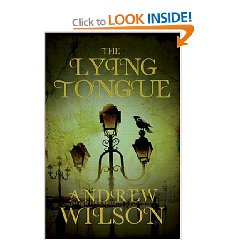
Andrew Wilson's d�but novel, �The Lying Tongue�, is narrated by Adam Woods, an art history graduate who has travelled to Venice intending to work on a novel of his own. He takes a job as assistant to Gordon Crace, who published one best-selling book in the 1960s, then retired from writing and now lives a hermit-like existence within the walls of his crumbling palazzo. Crace is eccentric, insisting that Adam remain in the palazzo at all times, except for the most essential trips outside; but the young man doesn't mind, because it gives him plenty of time for writing.
And then a discovery changes Adam's mind about the kind of book he wants to write. While he's sorting through Crace's correspondence, two letters stand out in particular: one from a woman wishing to write a biography of Crace, the other hinting at blackmail. Adam resolves to be the one to write Crace's biography, and contrives to go back to the UK, where he investigates the central mysteries of Gordon Crace's life: what inspired him to write a novel about a group of public schoolboys who decide to kill a teacher? Why did he really stop writing after all his success? And what caused Christopher Davidson � first Crace's pupil, later his tenant � to take his own life at the age of twenty?
As the answers to those questions are revealed over the course of �The Lying Tongue�, Wilson controls the flow of information well, leading the reader towards a particular conclusion before puling the rug from under one's feet; I found myself surprised by the plot twists more than once. The slow unfurling of character is another strength: it's no great revelation that Crace has skeletons in his cupboard, even though we don't know just what they are until the end; but it's quite another matter to discover that Adam is a nasty piece of work. About a third of the way into the text, we learn, chillingly, why his girlfriend left him � and, even more chillingly, that he doesn't take responsibility for his actions. After that, one starts to wonder what else he might do... Wilson can also write an effective scene: an example is where an ordinary conversation is 'intercut' with Adam's memories of breaking a man's arm. We have enough ingredients for a good read; where, then, does �The Lying Tongue� fall down?
To take the previous three points in reverse: Wilson's prose isn't always compelling; frankly, it can be downright tedious (as in several lengthy descriptions of Crace's untidiness) � but not often, and mostly near the beginning, so it's not too damaging. More problematic is the characterisation of Adam: what scuppers this is not that he's short on morals, but that he's also short on charisma. One ends up feeling that both Crace and Adam deserve all they get, which doesn't make for the most enjoyable reading experience. As for what the two of them do get: Wilson sets the scene nicely for a final confrontation back at Crace's palazzo, but that final� falls into melodrama, with some figurative moustache-twirling; and the very end neither gives the intended jolt, nor makes all that much sense if one pauses to think about it. In short, �The Lying Tongue� is the sort of book that can be described as 'promising': it's nearly where it wants to be � in some places, it is there � but overall, there's a distance to travel yet.
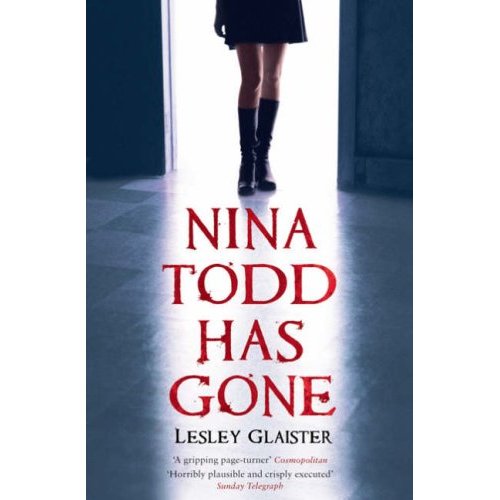
�Nina Todd Has Gone� is Lesley Glaister's eleventh novel, though the first that this reviewer has come across. It begins with a chance encounter in a Blackpool hotel, where Nina Todd is attending a conference, where she is chatted up by the handsome and charming Rupert, and ends up sleeping with him � much to her regret, as it means cheating on her partner Charlie. But Nina will have further reasons for regret, because this wasn't a chance encounter at all: 'Nina Todd' is Karen Wild, who has been released from prison on probation and given a new identity; 'Rupert' is really Mark Curtis, whose sister Isobel was killed by Karen, and who is determined to take his revenge.
This marks perhaps the key difference between �Nina Todd Has Gone� and �The Lying Tongue�: though the protagonists of both have their secrets, we know more (but not all) of them earlier on in Glaister's novel. In the tale that unfolds, Glaister skilfully exploits the dramatic irony, notching up the tension as Rupert/Mark gradually encroaches on Nina/Karen's life; and presenting subtly different versions of the same scenes from each protagonist's viewpoint, thereby revealing more of their characters. The author also has a knack for evocative prose: to take her imagery as an example, at one point Glaister describes cellar walls as smelling like 'cold mushrooms'. On first reading that, I thought it was absurd; but, when I thought about it for a moment, I realised how accurate it really was. I'm not sure whether some of the imagery (such as a 'melting cat' on a hot, sunny day) is startling or just daft; but, for the great majority of the novel, Glaister's prose is very effective indeed.
But what really makes �Nina Todd Has Gone� stand out for me � and the main reason I think it's more successful than Wilson's novel � is the complex reaction Glaister encourages us to have towards her characters. It doesn't feel inappropriate to dislike Adam Woods and Gordon Crace from �The Lying Tongue� intensely; but no simple emotional response feels right when considering Glaister's protagonists. We understand Mark's sense of injustice, yet we also see that he is himself deeply unpleasant and dangerous, and cannot condone his actions in going after Karen. Yet it's not possible to see her merely as a victim, either: there are hints enough that Nina/Karen isn't harmless (she thinks rather more about internal organs than the average person might, for one thing); and we find that Isobel's killing is explained, but not excused. In the end, it seems that bad things have happened to two people who were emotionally damaged beforehand; and that Glaister's intention may not be to judge so much as to show how difficult a moral problem can emerge from such a situation. That's what makes the book feel real and powerful.