| www.laurahird.com |
| THE NEW REVIEW |
|
Biography on the Wikipedia website


|
 |
|
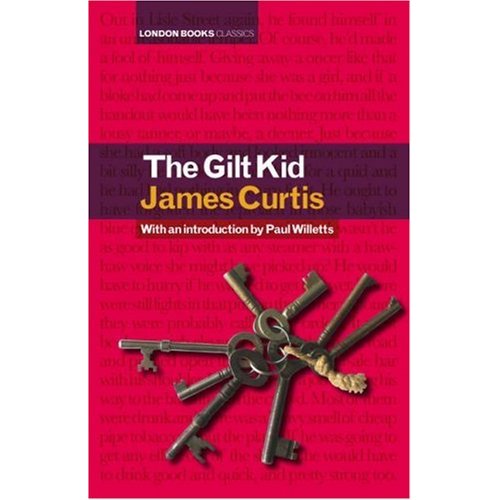
James Curtis is new to me, but he seems to have been been quite a success in the short period between the wars before fading almost completely from view. He died in 1977, having produced nothing for years. London have provided plenty of background in the introduction and notes. �The Gilt Kid� was his first novel, published in 1936 and typical of the times in its concern with poverty, crime and the great political movement of the twentieth century. So the kid himself is a petty thief lout, just out of prison and caught between the next job, the next drink and the copy of �Das Kapital� lying on his bedside table. He spends the first couple of days and the first half of the novel, moving from pub to pub, reacquainting himself with a variety of characters from his past and sorting out the next robbery. It's a bleak chain of dead-end boozers and desperadoes swirling through his half cut consciousness. At times you think that Curtis is taking the scene setting too far. Even some puking, shagging and the introduction of a sub plot involving an old girlfriend and her sugar daddy can't shift the sheer, numb boredom of chasing the next fix. Which in a way is the point. All of the characters in this part of the novel seem to exist in Kennedy's head, including Marx who pops up to explain the means of production and surplus value, sometimes through another character and sometimes in direct quotes. It's worth reading probably because it tells you about Curtis in the same way that Down and out in Paris and London tells you more about George Orwell than the situation it sets out to describe, and then manages to tell you much more about the times through that prism. It's a frightened, snarling, confused product of those times. . Like Orwell, Curtis is a boarding school boy who renounced his background (and adopted a pseudonym) to immerse himself in the underclass, and he suffers from the same issues that other writers of the era do. The characters ee and aww in all manner of cockney slang, while the narrator arrives at Hammersmith Broadway and surveys �one of London's focal centers,� workers clock off and 'become a man again..until then just another unit in the industrial system.' To most people the explicit politics and formal narration are going to jar, but they're a fact of time and place and class and don't spoil the book. . In the second half the novel becomes much more heavily plotted. A botched robbery results in an incredibly contrived set of circumstances which see the kid looking to avoid a murder charge, and there's a definite shift from his psyche to the outside world. It becomes much more like a conventional crime thriller, always though signposted with a heavy social message. The last 100 or so pages feel like a race to the conclusion, but the real strength of this novel is in the honest characterisation of the Gilt kid. . There's a short interview with Curtis' surviving daughter included, which is worth reading. Curtis own life does seem to have gradually descended into a lonely round of booze and impotent anger. And when his sister says that 'he couldn't cope with success and seemed intent on destroying everything good that ever happened to him', it's clear where the novel gets it's strength from. Another well deserved reissue from London books. Reproduced with permission
|
| THE GILT KID James Curtis (London Books 2007) Reviewed by Stuart Blackwood |
| If you would be interested in reviewing films/books for the site, contact me here |
| Book Review |
|
About Me Artists Best Tunes Books & Stuff Competition Contact Me Diary Events FAQ's Film Profiles Film Reviews Frank's Page Genre Bending Hand Picked Lit Links Heroes Index Links Lit Mag Central The New Review New Stuff Projects Publications Punk @ laurahird.com Recipes Samples Sarah�s Ancestors Save Our Short Story Site Map Showcase RELATED ITEMS Order Curtis�s �They Drive By Night�
Order Gerald Kersh�s �Night and the City�
Order Alan Sillitoe�s �A Start in Life�
|